Search my Blog

Tuesday, January 6, 2015

WAG 2014 Final Results published

Just received today a notification from Worked All Germany contest manager Chris, DL8MBS, that the final results of WAG 2014 Contest, including photos, contest audio extracts and breakdowns, have been published.

Results can be found here. If you participated, you may even download your certificate in .pdf format from here. Check mine below:


And WAG 2014 stories and other interesting facts on WAG contest will be found here.

I am now looking towards WAG 2015, to work some more rare DOKs for my DLD award hunting.

73 es HNY!
Stathis, SV5DKL

Wednesday, December 31, 2014

4th GTC CW Cup - Final Ranking - Detailed Scores


Just today have come out the final results of the 4th GTC CW Cup, after log-checking, in the official site of GTC.

Trophy winner of Cat. A` (SOAB) is Mike, SV8GKE and trophy winner of Cat. B`(SOAB/QRP) is Dimitris, SV1JGW. Congratulations to both for their achievements.

You will find the official final rankings of the 4th GTC CW Cup in the following URLs:

1) In Greek:   http://www.raag.org/displayITM1.asp?ITMID=790&LANG=GR

&

2) In English:   http://www.raag.org/displayITM1.asp?ITMID=790&LANG=EN

Looking forward to the 5th GTC CW Cup now, to take place 1st weekend of coming October 2015. See you all there!

Tuesday, December 2, 2014

YP10NATO Award

Returning home, after my participation in CQ WW CW DX Contest 2014, as M/S from SV1ENG's 2nd QTH in Kalamos, Attica Region, this is what I found in the mail:


It arrived automatically, without any applications in the first place. Nice going !!


Tuesday, November 4, 2014

Well performed DXpeditions provided 2 new DXCCs on 6m !!


!!! FINAL UPDATE - LOG COMPLETE !!!


Just TopBand CW and 30m RTTY not worked ...

SV5DKL has worked FT4TA on 22 out of 24 band slots

Propagation suggestions for FT4TA from DODECANESE or from CQ zone 20 or show on Geo Propagation Map
6m10m12m15m17m20m30m40m80m160m
PH          
CW          
RTTY          

---------------------------------------------------------------------------------------

It was about time we heard some serious DX on air !!

A couple of well organised DXpeditions that took place lately, have once again, kept me alert and on the radios for quite a few hours.

5R8M, from Nosy Be Island (AF-057), organised and performed by Mediterraneo DX Club (www.mdxc.org) has already ceased operations with approximately 70000 QSOs in their logs. I managed to get in their logs 18 times, 2 of which were on 6m (SSB/CW) giving me my 6m DXCC #104. The rest of my QSOs included 40m-10m and all modes worked.

 
Even before 5R8M ended, another large scale DXpedition began ...
 
FT4TA from Tromelin Island (AF-031), led by F6KOP & 6 very experienced French DXers & DXpeditioners (deriving from Lyon DX Gang), is currently activating Tromelin on all bands (160m-6m) and modes (SSB/CW/RTTY) and is scheduled to end on November 10th.
Further detailed information on Tromelin Island DXpedition can be found here:
 
 
Recalling the pileups of FT5ZM (Amsterdam Island) from last January, I have to admit that Tromelin's pileups are more amazing, more strict, a bit more disciplined, but at times they set a very wide split and it gets tough to find who the ops reply to, especially at the higher HF bands. Of course, what matters most is that they have HUGE signals in EU.
 
Once again, EU ops behaviour at the pileups justifies why US and JA ops are considered easier and more disciplined to work.
 
Tromelin was an ATNO for my SV5DKL callsign, since I had worked FR/F6KDF/T on 4 HF bands back in August 2000 from my Athenian QTH as SV1DKL !!
 
I set off to an early lead to finish off Tromelin at the higher HF bands, which was relatively easy (on all 3 modes, SSB,CW & RTTY). They were also extremely strong on 6m, too, with huge signal peaks even at +30db (in CW) and I had the joy to ask the op to work me in both modes, which he did !!


Tromelin was my 6m DXCC #105. Still missing many easy DXCCs on 6m, such as CU, GD, GU, HB0, 4U1 and many others, but I am not in a hurry right now !!
 
Until the end of the DXpedition, I will be focusing on the 3 lower bands, where I still miss Tromelin, although they are strong here in Rhodes (yes, on 160, too!).
 
Good luck to anyone chasing FT4TA, especially if it is a ATNO for you !!


Wednesday, September 17, 2014

TY1AA new one on 6m !!

The IDT (Italian DXpedition Team) have done it again, activating yet another rare DXCC from Africa.

This time it was Benin's turn, and the I2YSB company have already made almost 35k QSOs, under the callsign TY1AA, still going strong from their well appointed shack.

I was hunting them just for bands/modes I've been missing TY, but on 6m it was a totally new bandslot for my DXCC & DXCC Challenge totals.

On Sep. 14th afternoon, they were really strong on 6m CW and they had a big EU pileup, but a couple of calls under HP was all that was required to make it through ;-)


After Benin, I am happily numbering 103 DXCC on 6m, still waiting for less than 9 confirmations to be liable to apply for my 6m DXCC, too!
 

WPX Award of Excellence Plaque ... Done !!

A most prestigious plaque I've been chasing for several years is finally hanging on my trophy wall. It is actually the 2nd WPX AoE plaque awarded amongst the 4 Greek Amateur Radio DXCC entities (SV, SV5, SV9 & SV/A).

The WPX Award of Excellence plaque is the highest recognition of the CQ WPX Awards program, for having worked & confirmed amateur radio prefixes, under specific prerequisites.


To sum it up, one has to have accomplished ALL of the following:

1) At least 1000 prefixes confirmed in Mixed mode
2) At least 600 prefixes confirmed in SSB mode
3) At least 600 prefixes confirmed in CW mode
4) At least 160 prefixes from North America confirmed
5) At least 95 prefixes from South America confirmed
6) At least 160 prefixes from Europe confirmed
7) At least 90 prefixes from Africa confirmed
8) At least 75 prefixes from Asia confirmed
9) At least 90 prefixes from Oceania confirmed
10) At least 175 prefixes confirmed on 80m band
11) At least 250 prefixes confirmed on 40m band
12) At least 300 prefixes confirmed on 20m band
13) At least 300 prefixes confirmed on 15m band
14) At least 300 prefixes confirmed on 10m band

with Extra endorsements available for Digital modes, 160, 60, 30, 17, 12 & 6m bands, for those WHO have qualified.

Next plaques to be applied for soon will be the 5B DXCC (with endorsements for another 5 bands, so that it will be 10B DXCC), and the DXCC Challenge (as soon as I reach the 2000 level, currently numbering 1910 confirmed).

73
SV5DKL
 

Wednesday, August 6, 2014

SZ5RDS/p Activation of Stroggili Islet (IOTA EU-001) & Ipsili Lighthouse during the ILLW 2014

A group of 4 hams (SV5AZP, SV5DDT, SV5DKL & SV5KKA) all members of the Radio Amateur Association of Dodecanese (http://www.sz5rds.gr), will perform a mini DXpedition to Stroggili islet (IOTA EU-001), 5nm southeast of Kastellorizo (Megisti) island, during this year's ILLW (International Lighthouse & Lightship Weekend) on 16-17/08/2014.

Callsign to be used is
 SZ5RDS/p

Despite only military personnel is allowed on the islet, not only we managed to obtain all required permits for this operation, but we will be transferred to/from the islet by army's means.

Stroggili is a Greek small rocky islet administrated by Megisti Municipality and its area is approximately 1 sq.km (1,5km long by up to 700m).

A beautiful Lighthouse (named Ipsili) exists at the Southern part of Stroggili. It was originally put in service back in 1910, using oil lamp, which produced a luminosity of 20 nautical miles. It has a focal plane of 85 meters and it consists of a 6,6m high round tower. Since 1987, the Lighthouse operates automatically, solely with solar power and its current luminosity is 17 nautical miles. It is worth mentioning that before Cyprus enrolled the E.U., Stroggili islet used to be the southeasternmost part of European Union.

Our DXpedition will activate, in summary, the following:

  • DXCC: SV5 (Dodecanese)
  • IOTA: EU-001 (Dodecanese)
  • GIOTA: DKS-001
  • MIA: MGD-022
  • WLOTA: L-1653
  • ARLHS: GRE-123
  • ILLW: GR0003
Plus, we will take part in the International Lighthouse & Lightship Weekend.

The QTH Locator of Stroggili islet is: KM46TC (Maidenhead / Grid square)

The coordinates of the Lighthouse are:
  1. 36.10992, 29.63236
  2. 36° 6.595' N, 029° 37.942' E
  3. 36° 06' 36" N, 029° 37' 56" E


Our equipment will comprise of 2 fully equipped stations running 100w, modes to be used are SSB/CW/RTTY and we will use a 3el. mini beam for 10/15/20m, a λ/4 vertical for 40m, a Fritzel FD-4 Windom for 80-10m, a 5 el. 6m yagi and a 9 el. 2m yagi.

QSL will be via SV5AZP. Our logs will be uploaded to eQSL.cc and Clublog, right after the end of the DXpedition.

Links with further info on Stroggili islet and Ipsili Lighthouse are:


73 es hpe cu on Air
On behalf of the Team

Stathis, SV5DKL

Our Sponsors:


Friday, July 11, 2014

100.000 QSOs in log !!!

 
My first jubilee in my Amateur Radio career happened on the 8th July 2014, just a day after my 37th birthday !!
 
N4XU was the one to give me joy, calling my CQ DX in RTTY on 20m at my sunrise ... of course, we chit-chatted about this through RTTY and he was also happy for this special QSO with me.
 
I had promised to myself that the op of my 100.000th QSO would receive a commemorative present from me, accompanying my specially noted QSL card, sent directly.
 
So, N4XU is going to receive a small package with my QSL and several Greek goodies in it, as a sample of gratitude for calling me to reach 100k QSOs.
 
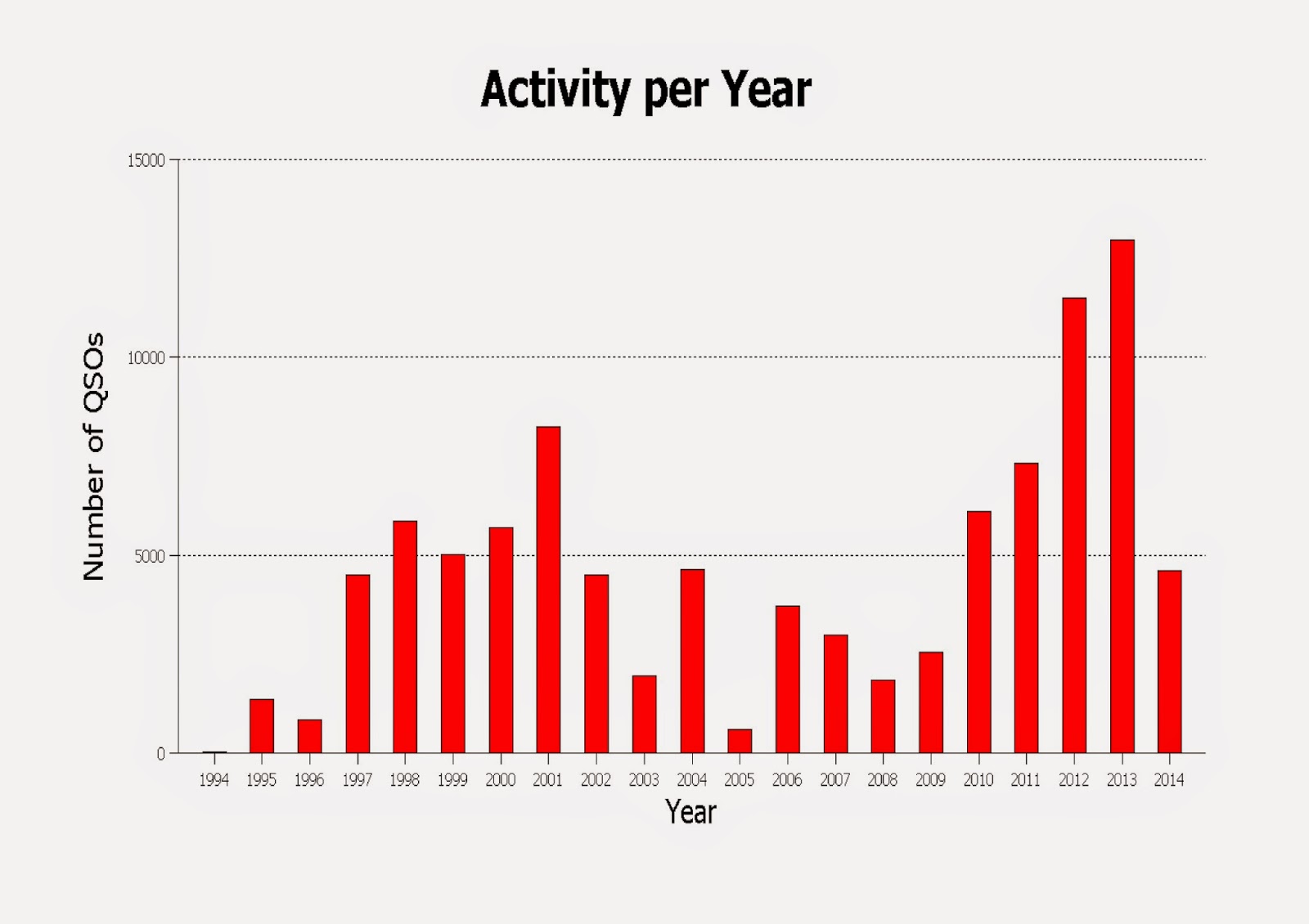
These 100.000 QSOs were all made by me from my amateur radio station, during the period October 1994 - July 2014 (almost 20 years, that is almost 5.000 QSOs per year on average).
 
Of course, I estimate that I have made at least another 35.000 QSOs from other radio stations, club stations, multi-op contest stations, jamboree stations, special event stations, etc. , but that is another story to tell ...
 
Below is a graph of how these 100.000 QSO are dispersed through these years:
 
 
and here is the respective screenshot of my LotW account with the jubilee number showing off on the Top right corner:  


 Using a clever statistics program written by a good friend of mine, I got some nice breakdowns for my activity over these years.
 
First of all, let's see how many days I've been active on-air for each of those 20 years, up to now:
 
 
Well, looks like 2012 has been my best year with 282/365 days of activity, while 2nd place goes to 1998 with 275/365 days of activity (was SV1DKL at that time, had just put up my 2 el. 5-band Lightning Bolt cubical quad and obtained a 2x813 linear amp !!).
 
Then, it's the battle of bands ... which has been my favourite and most active band ?? Let's see ...
 
 
As many would have expected, 20m is the winner, with 2013 being my most productive year so far, with just under 13k QSOs.
 
And last, but for sure not least, the battle of modes ... wonder if you can guess which one's on top ... here it goes:


Yup .. !! Contrary to what I initially thought, SSB took over CW by approximately 4000 QSOs, RTTY being waaaayyyyyy back at the line!
 
OK, then !!
 
Let the second round begin ... next stop ... 200k QSOs !!
And I am sure the fun will remain the same !!
 
73
Stathis, SV5DKL

Tuesday, July 8, 2014

SPE Expert 1K-FA front panel keyboard replacement ... DONE !!

I have been using the SPE Expert 1K-FA HF/50 Mhz mosfet linear amplifier for quite a few years. It is a a very intelligent piece of equipment, technologically advanced, with great capabilities and superb performance.

As you may already know, I am a keen contester, and 1K-FA has taken part with me in many many contests, with no signs of tear or wear.

However, since past winter, a problem came up with it, some of its front panel keys stopped operating. Since those not working were the most vital ones (ON/OFF/POWER/DISPLAY/OPERATE), I decided to contact SPE for technical advice. I only did that lately, because I mostly remote control the amplifier and all its functions through its software.

SPE`s customer support team is really prepared to face and give solution to virtually any problem that may come up with their products.

The explanation I was given for the fault, was that a specific point of the flat cable membrane that goes from the front panel to the CPU board, is constantly in touch with the left metallic chassis of the amp, and that causes a few cable lines to break as temperature rises progressively. A broken line, of course, means loss of some keys control.

I ordered a new front panel keyboard replacement, with a very low cost indeed (!), which arrived a few days later. In the envelope, there was also a piece of velcro to put between the new flat cable membrane and the point where it comes in contact with the left metallic chassis.

LET THE OPERATION BEGIN, THEN !!


After having removed top and bottom cabinets, I removed the front air filter to make the front panel extraction easier.


Front panel removed and unplugged from the main body of the amp. Although cabling connectors are very difficult to mix, it is better to take note (or a photo) of which cable of the main body goes to which connector of the front panel. It will save you from unneeded trouble !!
Also, note at the left part of the front panel, the flat cable membrane that connects the front panel keyboard with the CPU board ... that is the cause of the fault !!


 Several visible cracks amongst the cable lines of the membrane !! AHA !!


A better view of several of the cracked cable lines on the membrane.

The flat cable membrane end towards the CPU board ... looks like it needed a replacement, after all !!

Before accessing the keyboard, the CPU board has to be separated from the front panel. This is easily done by removing a few cables and four spacers.


Faulty keyboard removed from the front panel. Easily done with the help of a sharp knife, to cut through the powerful 3M glue used to stick the keyboard to the metallic chassis of the front panel. The LCD protective glass was cleaned with pure alcohol and a soft cloth to remove all remaining glue residues.


New keyboard placed on the front panel. Take great care in aligning both the four corners of the keyboard membrane, as well as the six small rectangular LED holes. Doing that right will help you later on when you will put the amp together again.

Here you may see the self-adhesive piece of Velcro, which I put between the keyboard flat cable membrane and the left side metallic chassis of the amp. From now on, chassis temperature will not affect this membrane.


Time for testing after repair ... Amp is back in business !!
100% success in this one.
I have to thank for their valuable help and technical notes Mr. Guido Pandolfi of SPE and Bob, W5UQ of Expert Amps USA.
Summary of repair:
Cost of keyboard: €10
Cost of shipping for keyboard: €6
Time of repair: 60 minutes, including unmounting and mounting the amp from/to the shack cabinets.
Result: All keyboard functions restored.

Wednesday, June 18, 2014

3rd GTC CW CUP final results published


The final results of the 3rd Greek Telegraphy Club (GTC) CW Cup have been announced today at the Official Web site of RAAG and GTC.
 
In particular, you may view the initially claimed scores here, the UBN reports after submitted logs' analysis here, and the final scores here.
 
Congratulations to the trophy winners of the two participation categories, as well as to everyone that participated in this enjoyable event.
 
We are looking forward to organizing an even more enjoyable 4th GTC CW Cup, during the first weekend of coming October (4-5/10/2014).
 
73/55
Stathis Maliakis, SV5DKL
E.C.M. - G.T.C.
G.T.C. #028
G.T.C. CW Cup Contest Manager


Monday, June 16, 2014

6m short skip Es made for my #101 DXCC (Z3)

Yesterday it was a challenging day for 6m. Es clouds everywhere, short skip present, long distance contacts easy at the same time ... fantastic!


I hadn't worked Z3 on 6m, although we are very close. But, yesterday's opening gave me 3 QSOs with Z3 stations, Z30U in SSB and Z35T & Z35Z in CW, for my DXCC entity #101 on 6m.

Between these QSOs, British stations were also quite strong here, worked a dozen of them, most of which were EIs. Kept monitoring the band for any transatlantic QSO, but it did not happen.

What was also very interesting was the fact that I worked an EA8 who was stronger when beaming to the North Pole (almost 90 deg. off his QTF) and a few Ukrainians that were stronger when beaming to Southwestern Europe (almost 80 deg. off their QTF).

Looks like we are having a somewhat unstable but very active 6m season.

Tuesday, June 10, 2014

Amateur Radio and Google's Street View

Google has implemented an interesting feature amongst its Services, called Street View.

Google's special cars equipped with panoramic roof-top cameras have driven all main roads of 77 countries until today, leading to a quite spectacular result.

Here is a view of my home QTH, with my antennas up on the roof:


Of course, some things have changed since the specific frame was captured, but you can get the main theme, anyway !!
 
Check for yourself whether your amateur radio setup has been "captured" by Google's photo lens and if it looks nice at http://www.google.com/streetview